
ACCORD CONSULTANTS
Trusted HR Consultancy in Pune functioning from 2009
Labour Law Updates Every HR Professional Should Know in 2026
Labour Law Updates Every HR Professional Should Know in 2026 have become increasingly important as Indian employers adapt to evolving workplace regulations, digital compliance, and changing workforce expectations.
The role of Human Resources has evolved far beyond hiring and employee engagement. Today, HR professionals are expected to ensure that every stage of the employee lifecycle—from recruitment and onboarding to payroll, statutory benefits, workplace safety, and employee exits—complies with applicable labour laws.
As businesses expand, adopt hybrid work models, and navigate changing regulations, staying updated on labour law developments has become a strategic necessity rather than an administrative task. Non-compliance can lead to financial penalties, legal disputes, operational disruptions, and reputational damage.
HR compliance is not just about avoiding penalties—it is about building a fair, transparent, and sustainable workplace.
Whether you are an HR Manager, business owner, factory manager, startup founder, or employer looking for a Recruitment Agency in Pune, staying updated with labour laws helps reduce legal risks while building a compliant workforce.
Companies partnering with an experienced Placement Consultancy in Pune can also streamline hiring processes while ensuring proper employee documentation from day one.
This guide explains the key labour law updates, compliance priorities, and HR best practices every organization should know in 2026.

Understanding Labour Law Updates Every HR Professional Should Know in 2026
Labour laws are legal provisions that regulate the relationship between employers and employees. They define the rights, responsibilities, benefits, and working conditions applicable across industries and business sectors.
These laws cover areas such as:
- Employee wages
- Working hours
- Overtime
- Leave entitlements
- Workplace safety
- Social security
- Provident Fund (PF)
- Employee State Insurance (ESI)
- Gratuity
- Maternity benefits
- Contract labour
- Industrial relations
- Prevention of workplace harassment
- Employee welfare
The Government of India has consolidated numerous labour laws into four Labour Codes, which are expected to streamline compliance and simplify labour regulations across the country as states complete implementation.
Why Labour Law Updates Every HR Professional Should Know in 2026 Matter
Many organizations assume compliance is only necessary during government inspections. In reality, labour law compliance directly impacts business continuity, employee satisfaction, and employer reputation.
A strong compliance framework helps organizations:
Many businesses also work with professional HR Consultancy Services to review policies, recruitment processes, and statutory documentation as part of their overall compliance strategy.
- Avoid legal penalties
- Reduce labour disputes
- Improve employee trust
- Enhance employer branding
- Strengthen corporate governance
- Build investor confidence
- Ensure smooth audits
- Improve HR efficiency
Compliance should not be viewed as a one-time exercise but as an ongoing process supported by accurate documentation, regular policy reviews, and employee awareness.
1. Labour Codes: Prepare Before Full Implementation
India’s labour reforms have consolidated 29 central labour laws into four comprehensive Labour Codes:
- Code on Wages, 2019
- Industrial Relations Code, 2020
- Occupational Safety, Health and Working Conditions Code, 2020
- Code on Social Security, 2020
Although implementation timelines vary across states, organizations should proactively align their HR policies and systems.
HR teams should review:
- Appointment letters
- Employment contracts
- Salary structures
- Standing orders
- Leave policies
- Working hour policies
- Payroll software
- Employee handbooks
- Compliance registers
Organizations that prepare early will face fewer operational challenges once the Codes are fully enforced.
2. Minimum Wages and Payroll Compliance
Payroll compliance remains one of the most critical HR responsibilities.
Minimum wage notifications are revised periodically by both central and state governments. Employers operating across multiple states must monitor these revisions carefully.
HR professionals should ensure:
- Employees receive at least the applicable minimum wage.
- Salary payments are made within statutory timelines.
- Overtime is calculated correctly.
- Wage deductions comply with legal provisions.
- Payroll records are accurate and up to date.
Regular payroll audits help identify errors before they become compliance issues.
3. Provident Fund (PF) and ESI Compliance
Social security benefits play a vital role in employee welfare.
Organizations covered under applicable laws should ensure:
- Timely PF contributions
- Accurate ECR filing
- Correct Universal Account Number (UAN) details
- Proper employee onboarding
- Timely exit processing
- Accurate ESI registration
- Correct employee classification
Even minor data discrepancies can create long-term complications for employees and employers.
4. Contract Labour Compliance
Many businesses engage contractors for housekeeping, security, logistics, manufacturing, maintenance, and support functions.
However, outsourcing does not eliminate employer responsibilities.
HR departments should periodically verify:
- Contractor licences
- Wage payment records
- Attendance registers
- PF compliance
- ESI compliance
- Bonus payments
- Statutory registers
- Safety compliance
Vendor compliance audits should be part of every organization’s risk management strategy.
5. Working Hours, Overtime, and Attendance
Flexible work arrangements have made attendance management more complex.
HR policies should clearly define:
- Working hours
- Weekly holidays
- Shift timings
- Overtime approvals
- Attendance systems
- Hybrid work expectations
- Remote work policies
- Compensatory leave rules
Digital attendance solutions should accurately record employee working hours while maintaining transparency.
6. Leave Management
Leave administration should comply with applicable state laws and organizational policies.
HR departments should maintain accurate records for:
- Earned Leave
- Casual Leave
- Sick Leave
- Maternity Leave
- Paternity Leave (where applicable)
- Festival Holidays
- National Holidays
- Compensatory Offs
Clearly documented leave policies reduce employee grievances and improve workplace transparency.
7. Prevention of Sexual Harassment (POSH)
The Prevention of Sexual Harassment (POSH) Act continues to be one of the most important workplace compliance requirements.
Organizations should ensure:
- Internal Committee (IC) formation where applicable
- Employee awareness programmes
- Manager sensitization
- Complaint redressal mechanisms
- Confidential investigations
- Annual compliance reporting
A strong POSH framework helps create a respectful, safe, and inclusive workplace.
8. Employee Documentation
Proper documentation protects both employers and employees.
During senior and leadership hiring, professional Executive Search Services also help ensure candidate documentation, background verification, and onboarding processes are completed accurately.
Essential HR documents include:
- Offer Letters
- Appointment Letters
- Employment Agreements
- Confidentiality Agreements
- Background Verification Reports
- KYC Documents
- Educational Records
- Experience Certificates
- Exit Forms
- Full & Final Settlement Records
Organizations should digitize employee records while ensuring secure storage and controlled access.
9. Workplace Safety and Employee Well-being
Employee well-being has become a key compliance focus.
Organizations should periodically assess:
- Fire safety
- Emergency evacuation procedures
- First-aid facilities
- Workplace ergonomics
- Mental wellness initiatives
- Occupational health practices
- Safety training programmes
A safer workplace improves productivity and reduces business risk.
10. Gig Workers, Freelancers, and Remote Employees
Modern organizations increasingly engage:
- Freelancers
- Consultants
- Remote employees
- Project-based professionals
- Gig workers
HR teams should clearly define:
- Employment status
- Scope of work
- Confidentiality obligations
- Payment terms
- Intellectual property ownership
- Data security responsibilities
Clear contracts reduce ambiguity and future disputes.
Common Labour Law Compliance Mistakes
Many organizations unknowingly expose themselves to compliance risks.
Some common mistakes include:
- Delayed salary payments
- Incorrect PF deductions
- Missing employee documentation
- Poor attendance records
- Improper overtime calculations
- Weak contractor compliance
- Inadequate POSH implementation
- Outdated HR policies
- Failure to monitor state-specific notifications
- Incomplete statutory registers
Regular internal audits help identify and resolve these gaps.
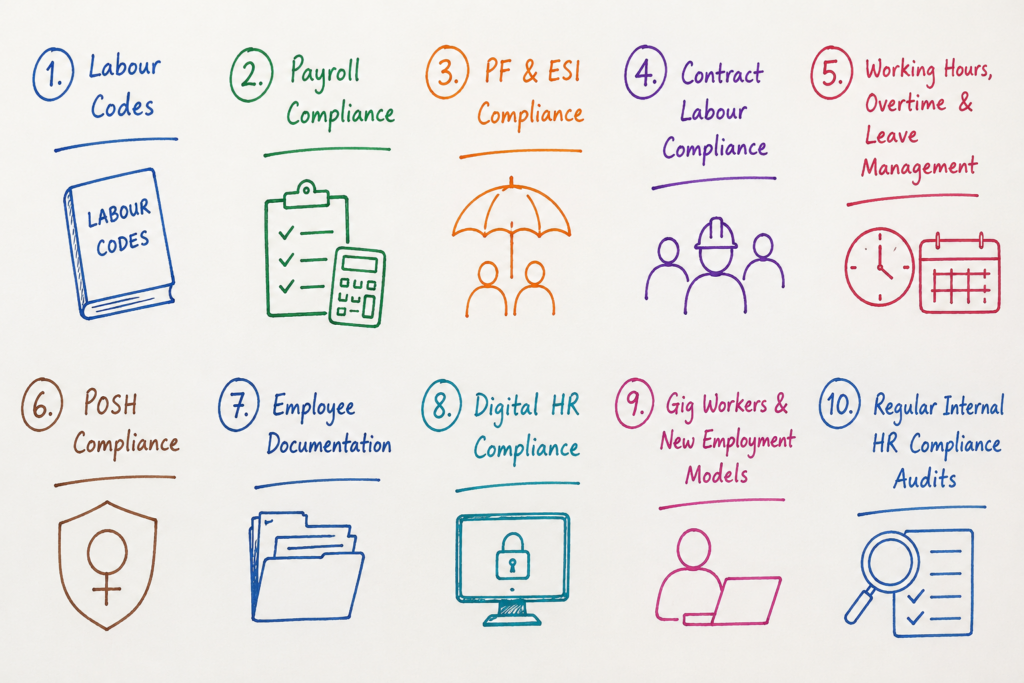
Labour Law Updates Every HR Professional Should Know in 2026 Checklist
Every HR department should periodically review the following:
- Appointment Letters
- Offer Letters
- Employment Contracts
- Employee Handbook
- Attendance Records
- Payroll Compliance
- Minimum Wage Compliance
- PF Contributions
- ESI Contributions
- Gratuity Records
- Bonus Compliance
- Leave Registers
- Contractor Compliance
- POSH Committee
- Training Records
- Employee Exit Documents
- Full & Final Settlements
- Statutory Registers
- Digital Employee Files
- Compliance Calendar
Maintaining this checklist can significantly reduce compliance risks.
Best Practices for HR Professionals
To stay ahead of changing regulations, organizations should adopt a proactive approach.
Recommended practices include:
- Conduct quarterly HR compliance audits.
- Monitor central and state labour notifications.
- Review HR policies annually.
- Automate payroll and statutory calculations.
- Digitize employee documentation.
- Train managers on labour law compliance.
- Conduct regular POSH awareness sessions.
- Maintain accurate employee records.
- Audit contractor compliance periodically.
- Consult legal experts whenever required.
Compliance should become part of organizational culture rather than a year-end activity.
How Recruitment Partners Support HR Compliance
Recruitment is often the first step in ensuring HR compliance. Hiring the right talent through a structured recruitment process helps organizations maintain proper documentation, follow standardized hiring procedures, and reduce compliance risks from the very beginning.
Working with an experienced recruitment partner helps organizations:
- Hire employees with complete documentation.
- Ensure structured onboarding.
- Maintain standardized hiring processes.
- Reduce hiring risks.
- Improve workforce planning.
- Build compliant recruitment workflows.
Since 2009, Accord Consultants has been helping organizations across manufacturing, engineering, information technology (IT), healthcare, pharmaceuticals, FMCG, logistics, retail, automotive, engineering services, and many other industries recruit qualified professionals through a systematic and transparent hiring process.
For organizations in the technology sector, our specialized IT Recruitment Agency in Pune services help companies hire software developers, cloud engineers, cybersecurity professionals, data analysts, AI specialists, and other technology professionals while ensuring structured recruitment practices and complete candidate documentation.
Our recruitment process emphasizes accurate candidate screening, complete documentation, structured hiring practices, and smooth onboarding, enabling employers to build strong, compliant, and high-performing teams.
FAQ
What are the four Labour Codes in India?
The four Labour Codes are the Code on Wages, Industrial Relations Code, Occupational Safety, Health and Working Conditions Code, and Code on Social Security. They consolidate multiple labour laws into a simplified framework.
Why is labour law compliance important?
Compliance helps organizations avoid legal penalties, improve employee satisfaction, maintain employer reputation, and reduce business risks.
How often should companies conduct HR compliance audits?
A quarterly compliance audit is generally recommended. Regular reviews help identify gaps before they lead to legal or operational issues.
What documents should every HR department maintain?
HR departments should maintain appointment letters, employment agreements, payroll records, attendance registers, leave records, PF and ESI documents, statutory registers, POSH records, and employee exit documentation.
Does labour law compliance apply to startups?
Yes. Startups are also required to comply with applicable labour laws based on their size, industry, employee strength, and the state in which they operate.
What is the role of HR in labour law compliance?
HR professionals are responsible for implementing company policies, maintaining statutory records, ensuring payroll compliance, supporting employee welfare, coordinating audits, and keeping the organization updated on legal requirements.
Conclusion
Labour law compliance is no longer just a statutory obligation—it is an essential component of responsible business management. As regulations evolve and workplaces become more dynamic, HR professionals must remain informed, proactive, and prepared to adapt.
By strengthening payroll processes, maintaining accurate documentation, implementing robust workplace policies, and conducting regular compliance audits, organizations can minimize legal risks while fostering a transparent and productive work environment.
Whether you are managing a startup, a growing MSME, or a large enterprise, investing in strong HR compliance practices today will contribute to sustainable growth and long-term organizational success.
If your organization is looking to strengthen its workforce through structured and professional recruitment, Accord Consultants has been helping businesses hire quality talent across industries since 2009. Our experience in executive search, recruitment, and talent acquisition enables companies to build capable teams while supporting efficient and compliant hiring practices.