
ACCORD CONSULTANTS
Expert Recruitment Solutions for Every Industry.
Advantages and Disadvantages of EPF Contribution Capped at ₹1,800: Impact on Employees and Employers

The recent clarification regarding the Employees’ Provident Fund (EPF) contribution has generated widespread discussion among employees, employers, HR professionals, and payroll teams. Many people interpreted the announcement as a reduction in Provident Fund benefits, while others believed employers would no longer contribute beyond ₹1,800 per month.
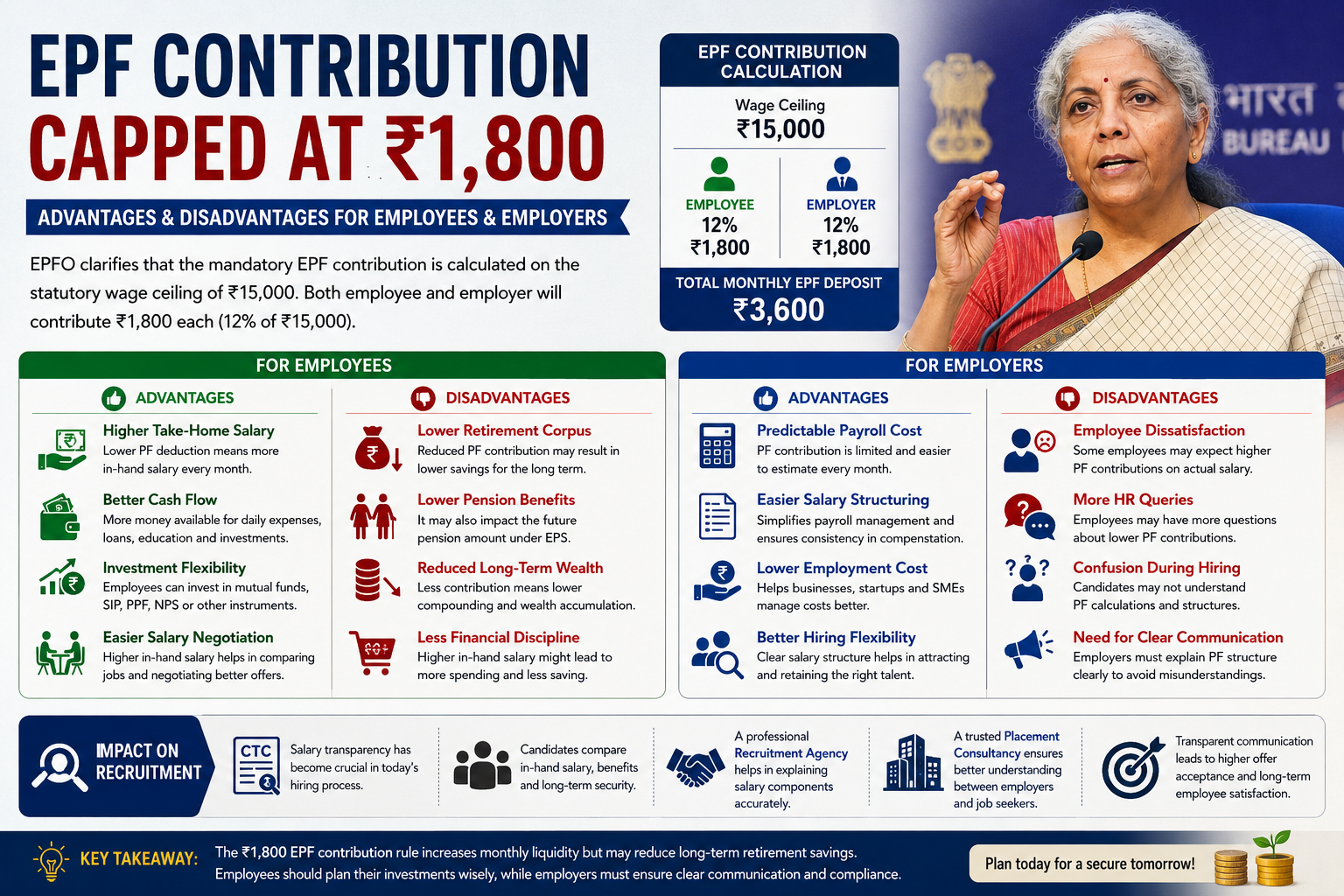
In reality, the clarification reiterates that the mandatory EPF contribution is calculated on the statutory wage ceiling of ₹15,000, which means both the employee and employer are required to contribute ₹1,800 each (12% of ₹15,000). Companies may still choose to contribute on a higher basic salary depending on their employment policies or contractual commitments.
This change has significant implications for salary structuring, recruitment, payroll management, retirement planning, and employee expectations. Every Recruitment Agency and HR professional should understand these implications to provide accurate guidance to employers and job seekers.
In this article, we explore the advantages and disadvantages of the ₹1,800 EPF contribution cap and what it means for employees, employers, and the recruitment industry.
What Is the ₹1,800 EPF Contribution Rule?
The Employees’ Provident Fund Organisation (EPFO) requires eligible employers and employees to contribute 12% of the employee’s basic salary and dearness allowance toward the EPF.
For mandatory contributions, the statutory wage ceiling is currently ₹15,000 per month.
This means:
- Employee Contribution: ₹1,800
- Employer Contribution: ₹1,800
- Total Monthly EPF Deposit: ₹3,600
If an employee’s basic salary exceeds ₹15,000, employers may voluntarily contribute on the actual basic salary, but the statutory minimum remains based on the wage ceiling.
Understanding this distinction is essential for HR departments, payroll professionals, and every Recruitment Agency involved in salary negotiations.
Advantages of the ₹1,800 EPF Contribution
1. Higher Monthly Take-Home Salary
One of the most noticeable benefits is the increase in monthly take-home salary for employees whose companies contribute only on the statutory wage ceiling.
For example, if an employee earns a higher basic salary but PF is deducted only on ₹15,000, the monthly deduction remains ₹1,800 instead of increasing proportionately.
This leaves more disposable income every month.
Employees can use the additional money for:
- Household expenses
- Children’s education
- Home loan EMIs
- Emergency savings
- Personal investments
2. Better Cash Flow
Higher take-home salary improves liquidity.
Many employees prefer having additional cash available each month rather than locking a larger portion into retirement savings.
This can especially benefit young professionals who are managing rent, loans, or family expenses.
3. Greater Investment Flexibility
Instead of contributing a larger amount to EPF, employees may choose to invest surplus funds in other financial instruments, such as:
- Mutual Funds
- SIPs
- National Pension System (NPS)
- Public Provident Fund (PPF)
- Fixed Deposits
- Equity Investments
Diversifying investments allows individuals to align their savings with their financial goals and risk appetite.
4. Predictable Salary Structure
For employers, calculating PF on the statutory wage ceiling simplifies payroll administration.
It enables HR teams to prepare standardized salary structures, reducing complexity during hiring and salary revisions.
This is particularly useful for startups, small businesses, and growing organizations.
5. Improved Hiring Competitiveness
Candidates often compare monthly in-hand salary when evaluating job offers.
Since lower mandatory PF deductions increase take-home pay, employers may find it easier to attract candidates who prioritize immediate income.
An experienced Recruitment Agency can explain these salary components clearly, helping candidates make informed decisions.
Disadvantages of the ₹1,800 EPF Contribution
1. Lower Retirement Savings
The biggest disadvantage is the reduction in long-term retirement savings.
EPF earns annual interest declared by the government, and regular contributions over several decades benefit from compounding.
Lower monthly contributions mean:
- Smaller retirement corpus
- Reduced long-term wealth creation
- Less financial security after retirement
Employees should carefully evaluate whether higher take-home salary is worth sacrificing future savings.
2. Lower Pension Benefits
A portion of the employer’s contribution supports the Employees’ Pension Scheme (EPS).
Lower pensionable wages may affect future pension benefits, making retirement planning even more important.
Employees should understand how EPF and EPS work together before making financial decisions.
3. Reduced Financial Discipline
EPF acts as a forced savings mechanism.
Many employees struggle to save consistently on their own.
Receiving higher take-home salary may encourage unnecessary spending rather than disciplined investing.
Without proper financial planning, employees could end up with inadequate retirement savings.
4. Confusion Among Employees
Recent news headlines have caused confusion.
Many employees mistakenly believe:
- EPF has been reduced.
- Employer contributions have stopped.
- Retirement benefits have been withdrawn.
In reality, the statutory contribution remains unchanged; the clarification relates to the wage ceiling used for mandatory contributions.
HR departments should communicate these details clearly.
Advantages for Employers
Payroll calculations become more consistent and predictable.
Finance teams can accurately estimate statutory liabilities without frequent adjustments.
Organizations can plan recruitment budgets more effectively because mandatory employer contributions are predictable.
This benefits:
- Manufacturing companies
- IT companies
- SMEs
- Startups
- Service industries
Clearly defined salary components improve transparency.
Employees understand:
- Basic Salary
- HRA
- Special Allowance
- Employer PF
- Employee PF
- Gross Salary
- Cost to Company (CTC)
A transparent compensation structure builds trust during recruitment.
Salary discussions become easier when recruiters explain PF calculations accurately.
A professional Recruitment Agency plays a crucial role in educating candidates about salary components, helping employers improve offer acceptance rates.
Disadvantages for Employers
Some experienced professionals prefer higher PF contributions because they value long-term retirement savings.
Employers may receive questions such as:
- Why is PF calculated only on ₹15,000?
- Why isn’t PF deducted on my full basic salary?
- Can I request higher PF deductions?
HR teams should be prepared with clear explanations.
Organizations may need to update:
- Offer letters
- Salary structure documents
- Employee FAQs
- Onboarding presentations
- Payroll policies
Clear communication minimizes misunderstandings.
Candidates are becoming more aware of compensation structures.
Recruiters should explain:
- Gross Salary
- Net Salary
- Employer Contribution
- Employee Contribution
- Retirement Benefits
A knowledgeable Placement Consultancy helps employers communicate these details effectively while ensuring candidates fully understand their compensation package.
Salary discussions become easier when recruiters explain PF calculations accurately.
A professional Recruitment Agency plays a crucial role in educating candidates about salary components, helping employers improve offer acceptance rates.
Impact on Recruitment and Hiring
Salary transparency has become an important part of recruitment.
Today’s candidates don’t simply compare annual CTC—they evaluate:
- Monthly take-home salary
- Retirement benefits
- Employer contributions
- Additional benefits
- Long-term financial security
Every Recruitment Agency should understand the latest EPF guidelines so that salary negotiations remain transparent and accurate.
Employers that clearly communicate salary structures are more likely to attract and retain skilled professionals.
What Should Employers Do Now?
Organizations should consider the following best practices:
- Review salary structures.
- Update payroll policies.
- Train HR and recruitment teams.
- Educate employees about EPF.
- Provide transparent CTC breakups.
- Explain employer and employee contributions during onboarding.
- Publish internal FAQs regarding PF calculations.
These proactive steps improve employee confidence and reduce payroll-related queries.
Advice for Employees
Before accepting a job offer, employees should ask:
- Is PF calculated on the statutory wage ceiling or actual basic salary?
- Can I voluntarily contribute more through VPF?
- What will be my monthly take-home salary?
- How will this affect my retirement planning?
- Does the company contribute above the statutory requirement?
Discussing these questions with HR or a trusted Placement Consultancy can help candidates make better career decisions.
Should Employees Opt for Higher PF Contributions?
There is no one-size-fits-all answer.
Higher PF contributions may be suitable for:
- Employees planning long-term retirement savings.
- Individuals seeking low-risk investments.
- Professionals who prefer disciplined monthly savings.
Lower PF contributions may suit:
- Young professionals.
- Individuals with higher financial commitments.
- Employees who actively invest in diversified financial instruments.
The right decision depends on individual financial goals, risk tolerance, and retirement planning.
FAQ
Is EPF contribution limited to ₹1,800?
The statutory mandatory contribution is ₹1,800 each from the employee and employer when calculated on the wage ceiling of ₹15,000. Employers may voluntarily contribute on higher wages depending on company policy.
Can employers contribute more than ₹1,800?
Yes. Many organizations voluntarily contribute on the employee’s actual basic salary.
Will my pension reduce?
Your pension benefits depend on the applicable EPS provisions and the wages considered under the scheme. Employees should review their specific employment terms.
Can I voluntarily contribute more?
Yes. Eligible employees may choose to contribute additional amounts through the Voluntary Provident Fund (VPF), subject to applicable rules.
Does this affect existing employees?
The impact depends on the employer’s existing PF policy and employment agreements.
Conclusion
The ₹1,800 EPF contribution clarification has sparked important conversations about salary structures and retirement planning. While the statutory contribution remains based on the existing wage ceiling, its practical impact varies depending on employer policies.
For employees, the primary advantage is a higher monthly take-home salary, while the main disadvantage is a potentially smaller retirement corpus. Employers benefit from predictable statutory costs and simplified payroll management but must communicate compensation structures transparently.
As recruitment becomes increasingly competitive, every Recruitment Agency and Placement Consultancy should stay informed about statutory changes so they can provide accurate guidance to employers and job seekers alike. Clear communication, proper financial planning, and transparent hiring practices will help organizations build trust and strengthen long-term employee relationships.