Last Updated: August 2026

ACCORD CONSULTANTS
Placement Consultancy for Job in Pune for Fresher & Professionals
How to Become an AI Engineer in India in 2026: Complete Career Roadmap
Artificial Intelligence is rapidly changing the way companies develop products, automate processes and make business decisions. From Generative AI and large language models to AI-powered automation and intelligent applications, companies increasingly need professionals who can build, deploy and maintain AI systems.
This has made AI Engineering one of the most promising technology career paths in India in 2026.
However, becoming an AI Engineer is not simply about learning ChatGPT, writing prompts or completing an introductory AI course. Employers increasingly need professionals who understand programming, data, machine learning, software engineering and how to turn AI models into reliable applications.
Recent industry discussions in India also point toward a growing gap between people who use AI tools and professionals who can actually build AI-powered applications, automations and agents.
So, how do you become an AI Engineer in India?
This guide explains the skills, qualifications, courses, projects, career roadmap, job opportunities, salary considerations and hiring expectations for aspiring AI Engineers in 2026.
For candidates planning a career in technology, understanding how IT recruitment and technology hiring works can also help when preparing for the job market.
AI Engineer in 2026: Skills, Qualifications and Career Scope
An AI Engineer is a technology professional who designs, develops, integrates and deploys artificial intelligence systems.
Depending on the organization, an AI Engineer may work on:
- Machine learning models
- Generative AI applications
- Large Language Models (LLMs)
- Natural Language Processing (NLP)
- Computer vision
- Recommendation systems
- AI-powered automation
- Retrieval-Augmented Generation (RAG)
- AI agents
- Predictive analytics
- Model deployment
- MLOps
- AI APIs and cloud-based AI applications
The role is increasingly becoming a combination of software engineering, machine learning and applied AI.
This is particularly important in 2026 because organizations are increasingly interested in applying AI to real business problems rather than experimenting with AI in isolation. Recent reporting on India’s AI hiring market points toward growing demand for professionals who can integrate AI into practical workflows and customer-facing applications.
What Does an AI Engineer Do?
The day-to-day responsibilities of an AI Engineer can vary depending on the company and specialization.
Typical responsibilities may include:
- Understanding a business problem that can be solved using AI
- Collecting and preparing relevant data
- Developing or selecting an appropriate AI or machine learning model
- Training, testing and evaluating models
- Integrating AI models with software applications
- Working with APIs and databases
- Building Generative AI applications
- Developing RAG-based systems
- Building or integrating AI agents
- Deploying AI applications to cloud or production environments
- Monitoring performance and improving model results
- Implementing security, evaluation and responsible AI practices
In other words, an AI Engineer is not necessarily someone who creates a new foundational AI model from scratch.
Many AI Engineers work on using existing models effectively and building reliable applications around them.
Why AI Engineering Is a Growing Career in India
India already has a large technology workforce, and AI is increasingly becoming part of software development, enterprise technology and Global Capability Centre (GCC) operations.
Recent reporting indicates that Indian GCCs are moving toward smaller, specialized teams with greater emphasis on AI and product engineering rather than simply expanding headcount.
This creates opportunities for professionals with specialized technical skills.
AI is also influencing areas such as:
- Software development
- Banking and financial services
- Healthcare technology
- Manufacturing
- Automotive and EV
- Retail
- E-commerce
- Logistics
- Pharmaceuticals
- Telecommunications
- Cybersecurity
- Business analytics
- Customer service
- Marketing technology
- Global Capability Centres
For job seekers, this means AI skills can be valuable across multiple industries rather than only in traditional technology companies.
As AI and technology roles evolve, candidates can benefit from understanding how IT recruitment services evaluate technical skills, experience and project-based capabilities.
AI Engineer Skills You Need in 2026
A strong AI Engineer should build skills in layers rather than trying to learn every new AI technology at once.
1. Python Programming
Python is one of the most important programming languages for AI and machine learning.
You should understand:
- Variables and data types
- Functions
- Object-oriented programming
- Lists, dictionaries and sets
- File handling
- Exception handling
- APIs
- Libraries and packages
- Virtual environments
- Basic testing
Important Python libraries include:
- NumPy
- Pandas
- Matplotlib
- Scikit-learn
- PyTorch
- TensorFlow
You do not need to become a Python language expert before starting AI, but you should be comfortable writing and understanding real programs.
2. Mathematics and Statistics
You do not necessarily need advanced mathematics to begin your AI career, but a working understanding of mathematics is important.
Focus on:
- Probability
- Statistics
- Linear algebra
- Vectors and matrices
- Calculus fundamentals
- Optimization
- Distributions
- Mean, median and variance
- Correlation
Understanding the underlying concepts will help you understand why machine-learning models behave differently under different conditions.
3. Machine Learning
Machine learning remains a fundamental part of AI engineering.
Learn concepts such as:
- Supervised learning
- Unsupervised learning
- Regression
- Classification
- Clustering
- Decision trees
- Random forests
- Gradient boosting
- Feature engineering
- Model evaluation
- Cross-validation
- Overfitting and underfitting
You should also understand metrics such as:
- Accuracy
- Precision
- Recall
- F1 score
- ROC-AUC
- Mean squared error
4. Deep Learning
After understanding machine-learning fundamentals, move into deep learning.
Important concepts include:
- Neural networks
- Activation functions
- Backpropagation
- CNNs
- RNNs
- Transformers
- Embeddings
- Attention mechanisms
Frameworks such as PyTorch and TensorFlow can help you develop practical experience.
5. Generative AI and Large Language Models
Generative AI has become an important area of AI engineering.
You should understand:
- Large Language Models
- Prompt engineering
- Tokens
- Embeddings
- Context windows
- Model inference
- Fine-tuning concepts
- Model evaluation
- LLM APIs
- Structured outputs
- Function/tool calling
However, learning prompt engineering alone is unlikely to be enough for a professional AI Engineering role.
A stronger candidate understands how an AI model fits into a complete application.
6. Retrieval-Augmented Generation (RAG)
RAG has become an important approach for building applications that need an AI model to work with external or private information.
A basic RAG system generally involves:
User question → Retrieval → Relevant information → LLM → Answer
For example, a company could build an internal HR assistant that answers questions using company policies, employee documents or recruitment guidelines.
Candidates interested in Generative AI should understand:
- Document processing
- Chunking
- Embeddings
- Vector databases
- Similarity search
- Retrieval
- Prompt construction
- Context management
- Evaluation
RAG should be learned as an application architecture rather than simply as a buzzword.
7. AI Agents and Agentic AI
Another rapidly developing area in 2026 is agentic AI.
AI agents can be designed to perform multi-step tasks using tools, APIs, data sources and workflows.
For example, an AI agent could potentially:
- Receive a customer request
- Search a database
- Retrieve relevant information
- Call an external API
- Perform a calculation
- Generate a response
- Escalate the issue to a human when required
Recent industry reporting in India shows increasing interest in agentic AI and specialized AI engineering capabilities.
But aspiring engineers should avoid learning agents before understanding the fundamentals.
A good sequence is:
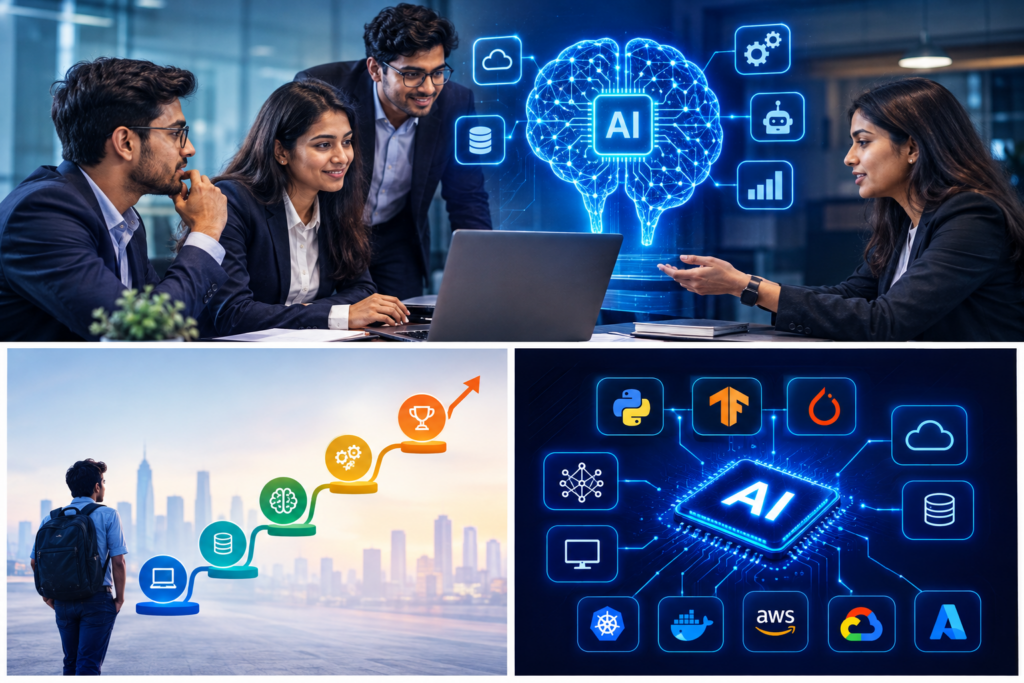
Programming → Data → Machine Learning → Deep Learning → Generative AI → RAG → AI Agents
8. SQL and Data Skills
AI Engineers work with data, so SQL is extremely useful.
Learn:
- SELECT queries
- Filtering
- Joins
- Aggregations
- Subqueries
- Common table expressions
- Window functions
- Database fundamentals
You should also understand how data is collected, cleaned, transformed and stored.
9. Cloud and MLOps
Building an AI model locally is different from running an AI application for thousands or millions of users.
That is why cloud and MLOps knowledge can differentiate candidates.
Learn the basics of:
- Cloud computing
- Containers
- Docker
- APIs
- CI/CD
- Model deployment
- Model monitoring
- Version control
- Logging
- Testing
- Scalability
10. Git and Software Engineering
AI Engineers are still software engineers.
Learn:
- Git
- GitHub
- Branching
- Pull requests
- REST APIs
- Testing
- Debugging
- Code documentation
- Application architecture
- Security basics
Along with technical knowledge, candidates should understand the skills employers look for in IT candidates, particularly when applying for competitive technology roles.

Educational Qualifications to Become an AI Engineer
There is no single mandatory degree that guarantees an AI Engineering job.
However, common educational backgrounds include:
- B.Tech / B.E. in Computer Science
- B.Tech / B.E. in Artificial Intelligence
- B.Tech / B.E. in Data Science
- B.Sc. Computer Science
- B.Sc. Data Science
- MCA
- M.Tech in AI, ML or Computer Science
- Related engineering and technology degrees
Candidates from mathematics, statistics, physics and other quantitative backgrounds may also transition into AI with the appropriate programming and engineering skills.
For employers, the degree is often only one part of the evaluation.
Practical skills, projects, internships, problem-solving ability and technical understanding can significantly influence whether a candidate is shortlisted.
Candidates should therefore focus not only on qualifications but also on building a profile that matches current IT job opportunities.
Best Courses to Become an AI Engineer in India
There is no single course that can make someone job-ready for AI Engineering.
Instead of choosing a course only because it contains “AI Engineer” in its title, evaluate whether it teaches both fundamentals and practical implementation.
A useful learning curriculum should cover:
Beginner Level
- Python
- Mathematics
- Statistics
- SQL
- Data analysis
- Git
Intermediate Level
- Machine learning
- Scikit-learn
- Deep learning
- PyTorch or TensorFlow
- Model evaluation
Sharing Personal Information Carelessly
Be cautious when submitting your resume, identification documents or financial information to unknown individuals or organizations.
Advanced Level
- Generative AI
- LLMs
- Embeddings
- RAG
- Vector databases
- AI agents
- APIs
- Cloud deployment
- MLOps
Practical Level
- Real-world projects
- GitHub portfolio
- Deployment
- Documentation
- Testing
- Interview preparation
AI Engineer Career Roadmap: Beginner to Job-Ready
A practical roadmap can be divided into several stages.
Stage 1: Learn Programming
Start with Python.
Build small applications instead of only watching tutorials.
Examples:
- Calculator
- File organizer
- Web API client
- Data analysis script
- Simple automation tool
Stage 2: Learn Data and Mathematics
Study:
- Statistics
- Probability
- SQL
- Pandas
- NumPy
- Data visualization
Work with publicly available datasets.
Stage 3: Learn Machine Learning
Learn the major machine-learning algorithms and understand when to use them.
Build projects such as:
- House-price prediction
- Customer churn prediction
- Sales forecasting
- Fraud detection
- Customer segmentation
Stage 4: Learn Deep Learning
Move into:
- Neural networks
- CNNs
- Transformers
- PyTorch or TensorFlow
Build at least one meaningful deep-learning project.
Stage 5: Learn Generative AI
Learn how modern AI applications use:
- LLM APIs
- Embeddings
- Prompting
- Structured outputs
- Tool calling
- Evaluation
Then build applications rather than simply experimenting with chatbots.
Stage 6: Learn RAG and AI Agents
Build increasingly sophisticated systems.
Examples:
- PDF question-answering system
- Company knowledge assistant
- RAG chatbot with citations
- AI agent connected to tools or APIs
Stage 7: Learn Deployment
Take at least one project from:
GitHub → API → Cloud → Live application
AI Engineer Projects to Build for Your Portfolio
Aim for 3–5 strong projects rather than 20 basic tutorial projects.
Project 1: AI Resume Analyzer
Build an application that analyzes a resume against a job description and identifies:
- Missing skills
- Relevant skills
- Experience alignment
- Keyword gaps
- Suggested improvements
Project 2: RAG-Based Knowledge Assistant
Build a system that answers questions from a collection of documents.
Include:
- Document ingestion
- Chunking
- Embeddings
- Vector search
- LLM response
- Source references
Project 3: AI Customer Support Assistant
Create an AI application that answers customer questions and escalates complex queries.
Project 4: AI Agent
Build an agent that can use tools such as:
- Search
- Calculator
- Database
- APIs
- Internal documents
Project 5: Predictive Machine-Learning Model
Build a traditional ML project such as:
- Customer churn prediction
- Demand forecasting
- Fraud detection
- Employee attrition prediction
What Should an AI Engineer Portfolio Include?
Your GitHub profile should not simply contain code.
For each major project, explain:
- Problem statement
- Approach
- Technologies used
- Data used
- Architecture
- Challenges
- Evaluation
- Improvements
Include screenshots, diagrams and clear documentation.
AI Engineer Jobs in India in 2026
AI Engineering is not limited to one job title.
Common roles include:
- AI Engineer
- Machine Learning Engineer
- Generative AI Engineer
- Applied AI Engineer
- NLP Engineer
- Computer Vision Engineer
- MLOps Engineer
- AI Solutions Engineer
Candidates looking for technology opportunities can also explore an IT recruitment agency in Pune that works with employers across technology and other industries.
Where Can AI Engineers Find Jobs in India?
AI professionals can find opportunities across:
- IT Services
- Product Companies
- Global Capability Centres
- Startups
- Manufacturing
- Banking and Financial Services
AI Engineer Jobs for Freshers
Freshers should focus on demonstrating practical ability through:
- Projects
- GitHub
- Internships
- Certifications (supporting role)
Fresh graduates who need guidance with their job search can also explore a placement consultancy for job seekers that connects candidates with suitable employment opportunities.
How Experienced IT Professionals Can Move Into AI Engineering
Experienced professionals can transition by building AI-specific skills:
- Software Developer → AI Engineer
- Data Analyst → AI/ML Engineer
- DevOps Engineer → MLOps Engineer
- Full-Stack Developer → Generative AI Engineer
Professionals planning such a transition can also monitor IT recruitment opportunities in Pune and compare roles based on their existing technical experience and newly acquired AI skills.
What Recruiters Look for in an AI Engineer Resume
Recruiters evaluate:
- Technical skills
- Real projects
- Experience clarity
- Portfolio (GitHub/live apps)
A well-structured resume is particularly important when competing for specialized technology positions. Candidates should also prepare for interviews and clearly explain their technical projects and achievements.
A well-structured resume is particularly important when competing for specialized technology positions. Candidates should also prepare for interviews and clearly explain their technical projects and achievements.
AI Engineer Salary in India in 2026
Salary depends on:
- Experience
- Skills
- Company
- Location
- Specialization
- Project experience
Focus on building skills and real-world capability rather than targeting a fixed number.
AI Engineer Interview Preparation
Prepare for:
- Python and programming
- Machine learning
- Deep learning
- Generative AI
- System design
Common Mistakes to Avoid When Starting an AI Career
- Only learning prompt engineering
- Collecting certificates without projects
- Ignoring programming
- Skipping ML fundamentals
- Building only tutorial projects
- Ignoring deployment
- Following every AI trend
AI Engineer Career Roadmap: 3-Month, 6-Month and 12-Month Plan
First 3 Months
- Python
- SQL
- Statistics
- Basic ML
3–6 Months
- Machine learning
- Deep learning
- NLP
- Generative AI
6–12 Months
- RAG
- AI agents
- Cloud
- Deployment
- MLOps
What Skills Will Matter Most for AI Engineers in the Future?
- Focus on:
- Programming
- Problem solving
- Data understanding
- Machine learning
- Software engineering
- System design
- AI evaluation
Is AI Engineering a Good Career in India in 2026?
Yes, but success depends on building real engineering capability, not just tool usage.
Frequently Asked Questions About Becoming an AI Engineer in India
Yes, but success depends on building real engineering capability, not just tool usage.
Can I become an AI Engineer without a Computer Science degree?
Yes, with strong programming and AI skills.
Can a fresher become an AI Engineer?
Yes, with strong projects and fundamentals.
Is Python necessary for AI Engineering?
Yes, it is strongly recommended.
Is Generative AI enough to become an AI Engineer?
No, fundamentals are essential.
Do I need to learn mathematics for AI Engineering?
Yes, at a practical level.
Should I learn RAG in 2026?
Yes, after fundamentals.
Should AI Engineers learn AI agents?
Yes, after core concepts.
How many AI projects should I put on my resume?
3–5 strong projects.
Can software developers transition into AI Engineering?
Yes, very effectively.
Are AI jobs available only in Bengaluru?
No, across India and remote roles.
Final Thoughts: Building an AI Engineering Career in 2026
Accord Consultants works with employers and job seekers across IT and Non-IT recruitment. If you are exploring your next career opportunity, you can learn more about our recruitment and placement services and stay connected with relevant job opportunities.
The AI job market is evolving quickly, but fundamentals remain stable.
Focus on:
Programming → Data → Machine Learning → Deep Learning → Generative AI → RAG → AI Agents → Deployment
Build real projects and solve real problems.
That is what turns learning into a career.